
Insurance Reinspections in Florida: When They’re Required and What Inspectors Document
- January 22, 2026
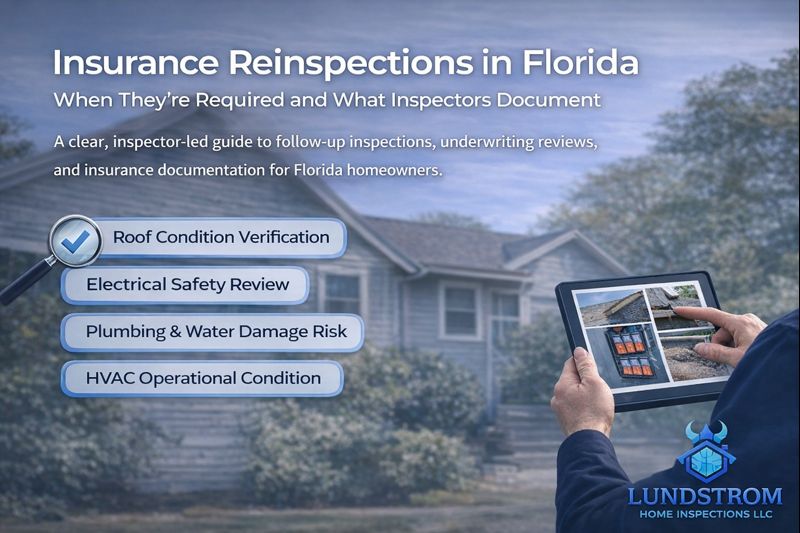
For many Florida homeowners, an insurance reinspection comes as an unexpected step—often after a policy application, renewal review, or repair request.
These inspections are not routine home inspections, and they are not designed to uncover every issue in a property. Their role is specific: to verify whether requested conditions or repairs have been addressed and to document current risk factors for the insurer.
Understanding when insurance reinspections are required, what inspectors are asked to document, and how insurers use the results helps homeowners avoid delays, misunderstandings, and unnecessary stress.
What an Insurance Reinspection Is (and What It Is Not)
An insurance reinspection is a limited follow-up inspection requested after an insurance company has identified specific underwriting concerns. These concerns typically arise during policy application, renewal review, or evaluation of prior inspection documentation.
The purpose of a reinspection is narrowly defined. It is not intended to provide a comprehensive assessment of the home or evaluate compliance with current building codes. It also does not represent an approval or denial of insurance coverage.
Instead, the reinspection is designed to confirm one specific point for the insurer:
Whether the conditions or repairs previously identified have been addressed and whether the property now meets the insurer’s acceptable risk criteria at the time of review.
Clear Insurance Decisions Start With a Professional Home Inspection
Insurance reinspections and underwriting reviews depend on clear documentation of roof, electrical, plumbing, and HVAC conditions. A properly performed home inspection provides the verification insurers need to evaluate risk accurately.
When Florida Insurance Companies Require a Reinspection
In Florida, insurance reinspections are not random or routine. They are typically initiated only after an insurer has identified a specific underwriting concern that requires verification. The trigger is almost always tied to risk clarification, not curiosity or general maintenance.
The most common scenarios are outlined below.
Reinspections After Required Repairs or Corrections
The most frequent reason for an insurance reinspection occurs after an insurer has requested specific repairs as a condition of issuing or continuing coverage.
This commonly follows:
A 4 point inspection submitted during underwriting
A roof condition evaluation
An underwriting review that identified observable hazards
When an insurer requests repairs, they are not relying on homeowner statements alone. A reinspection is used to independently confirm that the identified issues were addressed and that no visible hazards remain at the time of follow-up.
The reinspection is limited to the items flagged by the insurer. Inspectors are not reassessing the entire property or issuing opinions on unrelated components.
Reinspections During Policy Renewal Reviews
Insurance companies in Florida regularly reassess risk at renewal, particularly for older homes or properties with prior underwriting notes.
A reinspection may be required at renewal when:
Prior inspection documentation is outdated
System conditions were previously marginal or conditional
The insurer lacks current verification of key components
In these cases, the reinspection is used to confirm present conditions, not to identify new upgrades or improvements. The goal is to determine whether the property still meets the insurer’s acceptable risk criteria at the time of renewal.
Reinspections Following Underwriting Field Surveys
Some insurers, including Citizens Property Insurance Corporation, reserve the right to conduct underwriting field surveys during the life of a policy. These surveys may be exterior-only or interior and exterior, depending on the circumstances.
If a field survey identifies:
Safety hazards
System deficiencies
Deterioration affecting insurability
The insurer may require repairs and request a reinspection afterward to verify that those specific conditions have been corrected. The reinspection serves as documentation for underwriting, not as a replacement for the original survey.
Reinspections Tied to Conditional or Restricted Coverage
In some situations, coverage may be issued with explicit conditions, such as:
Repairs required within a defined timeframe
Temporary acceptance pending correction of deficiencies
A reinspection is then required to confirm whether those conditions were met within the allowed period. Failure to provide acceptable documentation may result in coverage modification, non-renewal, or cancellation, depending on the policy terms.
In these cases, reinspections are procedural—not discretionary.
Who Orders and Pays for an Insurance Reinspection
This depends on the type of reinspection:
Insurer-initiated field surveys are typically ordered and paid for by the insurance company.
Eligibility-related reinspections—such as follow-ups after repairs—are usually the homeowner’s responsibility and must be performed by a qualified, licensed inspector.
Understanding this distinction helps homeowners avoid confusion during underwriting.
What Insurance Reinspections Are Intended to Document
Insurance reinspections are verification-based, not exploratory. Inspectors are not searching for new issues or reevaluating the entire property. Their role is to document specific items identified by the insurance company and confirm whether those items now meet underwriting expectations.
The scope of documentation is determined by the insurer’s request, and the inspection is limited to those concerns.
Roof Condition Verification
When roof-related concerns are identified during underwriting, insurance reinspections are used to verify current roof condition, not to reassess design, installation methods, or workmanship. Inspectors are typically asked to document whether:
Previously identified repairs or roof replacements were completed
There are no visible signs of active leakage, damage, or material deterioration
The roof’s observable condition is consistent with the remaining service life expectations outlined by the insurer
Roof-related reinspection requests most often originate from findings documented during an initial 4 point inspection, where roof age, material, and observable condition are evaluated for insurance eligibility.
Clear, current photographic documentation is essential. Insurance underwriters rely heavily on visual evidence to confirm roof condition and to verify that prior issues have been properly addressed.
Electrical System Corrections
Electrical reinspections focus on safety-related conditions, not modernization. Inspectors may be asked to confirm that:
Flagged panels or components have been replaced or corrected
Unsafe wiring conditions have been addressed
There are no visible signs of overheating, corrosion, or exposed conductors
Inspectors document observable conditions at the time of inspection. They do not evaluate future performance or long-term reliability.
Plumbing Repairs and Water Damage Risk
Plumbing-related reinspections often address concerns tied to prior leaks or water damage exposure. Documentation may include verification that:
Identified leaks were properly repaired
Damaged or deteriorated components were replaced
There is no evidence of active moisture intrusion
Water heaters were replaced or corrected when previously flagged
Because water damage claims are a significant loss factor in Florida, insurers tend to be especially cautious when reviewing plumbing-related reinspections.
HVAC System Conditions
HVAC reinspections are generally limited to confirming that prior issues were corrected. Inspectors may document:
Replacement of systems that were previously non-operational
Correction of improper installations or drainage issues
Absence of damage that could contribute to water intrusion or safety concerns
System efficiency is not evaluated. From an insurance standpoint, the focus remains on operational condition and risk exposure.
How Insurance Companies Use Reinspection Reports
Once a reinspection is completed, the report is reviewed by the insurer’s underwriting department. The report helps determine whether:
Requested repairs were completed as specified
Previously identified risks have been reduced or resolved
Coverage can proceed without additional conditions
Inspectors do not approve, deny, or modify insurance coverage. Their responsibility is to provide accurate, objective documentation so insurers can make underwriting decisions based on verified information.
Common Misunderstandings About Insurance Reinspections
Insurance reinspections are often misunderstood, which can lead to unnecessary frustration or unrealistic expectations. Clarifying a few common misconceptions helps homeowners approach the process more effectively.
Reinspections Are Not “Pass or Fail”
Insurance reinspections are not pass/fail evaluations. Inspectors do not approve or reject properties for coverage. Their role is limited to documenting current conditions and verifying whether previously identified items were addressed.
Insurance companies—not inspectors—determine whether those documented conditions meet underwriting standards.
Cosmetic Improvements Do Not Influence Insurance Decisions
Cosmetic repairs, upgrades, or general property improvements do not affect reinspection outcomes unless they directly relate to risk-related components identified by the insurer.
From an insurance perspective, appearance matters far less than condition, safety, and exposure to loss.
Verbal Explanations Do Not Replace Documentation
Insurance companies rely on written reports and photographic evidence. Verbal explanations, homeowner statements, or assurances are not used in underwriting review.
If a condition cannot be verified through documentation, it is typically treated as unresolved from an insurance standpoint.
How Homeowners Can Prepare for an Insurance Reinspection
Preparation for a reinspection should emphasize completeness and documentation, not appearance.
Practical preparation includes:
Completing all requested repairs fully, not partially
Retaining invoices, permits, or contractor documentation when applicable
Ensuring inspectors have clear access to repaired areas
Allowing sufficient time for underwriting review after the inspection
Incomplete or rushed repairs are a common reason reinspections result in follow-up requests.
How Insurance Reinspections Differ From Other Inspections
Insurance reinspections serve a very different purpose than other inspection types and should not be confused with them.
A full home inspection evaluates overall property condition for the buyer or homeowner
A 4 point inspection establishes baseline insurability for older homes
A wind mitigation inspection documents construction features for discount eligibility
A reinspection exists solely to verify specific conditions previously identified by the insurer. It should not be substituted for another inspection unless the insurance company explicitly permits it.
Why Accuracy Matters More Than Speed
In Florida’s insurance environment, accurate documentation benefits both homeowners and insurers. Reports that are incomplete, unclear, or inconsistent often lead to underwriting delays, additional inspections, or policy complications.
Experienced inspectors understand how insurance companies review reports and focus on clear, objective documentation rather than assumptions, opinions, or unnecessary commentary.
Final Thoughts
Insurance reinspections are a normal part of Florida’s insurance process, particularly for older homes or properties with recent repairs. While they can feel stressful, their purpose is practical: confirming that known risks have been addressed and that coverage decisions are based on verified, current information.
Homeowners who understand the reinspection process, complete repairs thoroughly, and provide clear documentation are far more likely to experience smooth underwriting outcomes.
Many reinspection requests stem from issues first identified during an initial home inspection, which is why accurate reporting and clear documentation from the beginning are so important. Working with a certified home inspector helps ensure that inspections and follow-up documentation are completed objectively and in a manner insurers can review efficiently.